
Shared purpose is the point at which corporate mission, individual values and the lived experience of work become mutually reinforcing. It is not a slogan. It is an operating architecture.
The proposition
Purpose creates value when people can see their contribution and trust the evidence behind the claim.
The risk
Mission language without leadership and system alignment increases cynicism rather than commitment.
The response
Measure purpose through perception, behaviour, systems and outcomes—not sentiment alone.
The employment relationship is being renegotiated amid low engagement, accelerated skills change, institutional distrust and greater transparency. Competitive pay and baseline benefits remain essential, but they do not by themselves explain why skilled people contribute discretionary effort, remain through uncertainty or recommend an organisation to others.
Shared does not mean identical. A credible architecture allows different identities, motivations and cultural perspectives to coexist around a common direction. It creates line-of-sight without requiring ideological conformity and invites challenge when the organisation fails to live up to its commitments.
The global evidence base
Gallup’s State of the Global Workplace 2026 reports that global employee engagement fell to 20% in 2025 and estimates US$10 trillion in lost productivity. This does not prove that purpose alone repairs engagement; it demonstrates the scale of the wider system failure.
A separate 2026 Gallup United States analysis found employees with a strong sense of work purpose were 5.6 times as likely to be engaged. Deloitte’s 2026 Gen Z and Millennial Survey, reflecting more than 22,500 respondents, describes younger workers seeking sustainable progress, skills, stability and wellbeing. The World Economic Forum Future of Jobs Report 2025 identifies skills gaps as the most-cited barrier to transformation, nominated by 63% of surveyed employers.
Academic research provides an important foundation without reducing purpose to a recruitment slogan. Kristof-Brown, Zimmerman and Johnson’s meta-analysis examines the consequences of fit across person, job, organisation, group and supervisor. Rosso, Dekas and Wrzesniewski synthesise multiple sources and mechanisms through which work becomes meaningful. The implication is structural: meaning is shaped by the work, relationships, identity, context and systems people actually experience.
Evidence boundary
External research informs the context and design principles. It does not validate Diversity Australia’s proprietary models, imply endorsement or establish that purpose causes a particular commercial outcome. Claims should be tested within each enterprise and workforce segment.
The Contemporary EVP Framework
Diversity Australia’s Contemporary EVP Framework treats the employee value proposition as a connected value-exchange system rather than a campaign or list of benefits. Shared Purpose is the fifth dimension, but it cannot compensate for a breakdown in connection, flexibility, growth or wellbeing.
Deeper Connections
Authentic peer networks, trust, belonging and leadership accessibility.
Radical Flexibility
Meaningful autonomy in where, when and how work is delivered.
Personal Growth
Learning, mobility, mentorship and visible career pathways.
Holistic Well-being
Physical, psychological, social and financial sustainability.
Shared Purpose
Alignment between enterprise mission, individual values and social contribution.
The Diversity Australia Shared Purpose Architecture
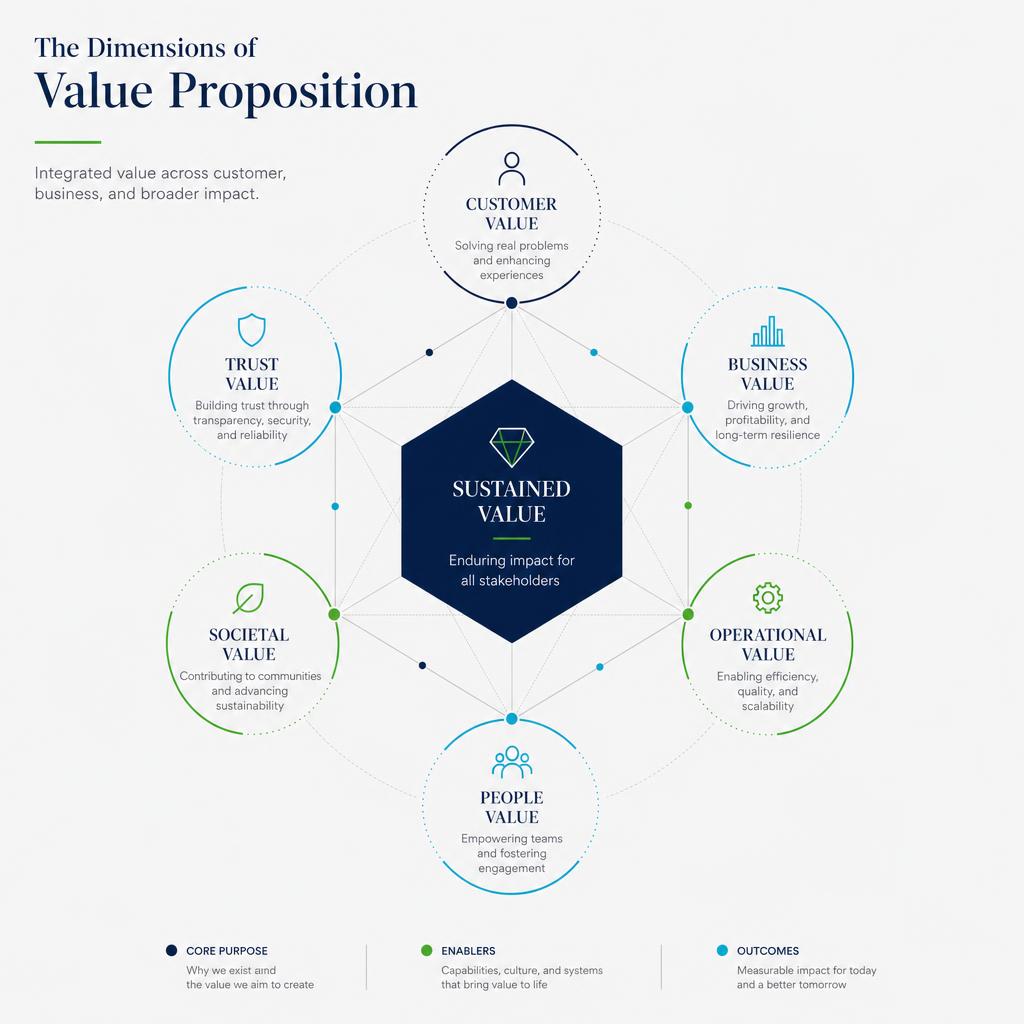
Purpose becomes credible only when six mutually dependent layers reinforce one another. A clear mission without leadership proof is rhetoric. Strong social impact without employee voice is fragile. Role line-of-sight without values reciprocity becomes one-way performance pressure.
Mission Truth
01Is the contribution specific enough to guide a real choice?
A clear enterprise contribution and strategic direction that can determine priorities, investment and trade-offs.
Values Reciprocity
02What can each party reasonably expect from the other?
A mutual value contract that translates stated values into obligations for the organisation, leaders and workforce.
Leadership Proof
03Which visible decisions demonstrate that the purpose is real?
Executive choices, resource allocation and accountability that provide observable evidence of the stated purpose.
Role Line-of-Sight
04Can each team explain its contribution without corporate jargon?
A traceable connection from mission to customer, function, team priorities and individual work.
Voice & Belonging
05Can people shape the purpose and challenge inconsistency safely?
Participation, psychological safety and inclusion mechanisms that allow diverse employees to influence enactment.
Societal Legitimacy
06Would the external claim withstand stakeholder scrutiny?
Consistency between public commitments, operational impacts, partnerships and the internal employee experience.
Leaders can use the architecture as a decision test: Does this choice express mission truth? Is it reciprocal? What leadership proof will employees observe? Can teams connect it to their work? Whose voice is missing? Would the external claim withstand scrutiny?
The Structural Purpose Alignment Index
The Diversity Australia Structural Purpose Alignment Index converts the architecture into a 0–100 diagnostic. It is a proprietary management instrument, not an international standard. Its purpose is to combine employee perception with behavioural and system evidence so boards do not mistake a high-level sentiment result for structural alignment.
Normalisation formula
Dimension score = ((mean survey score − 1) ÷ 4) × 100
Enterprise score = the weighted sum of all six dimension scores.
| Dimension | Weight | Employee signal | Structural evidence |
|---|---|---|---|
| Mission Clarity | 15% | I understand the contribution our organisation exists to make. | Strategy choices, capital allocation and enterprise priorities. |
| Leadership Congruence | 20% | Leaders make difficult decisions in ways that reflect our stated purpose. | Decision logs, executive objectives, incentives and consequences. |
| Role Contribution | 15% | I can explain how my work contributes to the enterprise mission. | Goals, role design, team plans and customer outcome measures. |
| Values Experience | 20% | My everyday experience is consistent with the values we communicate. | Recruitment, onboarding, performance, reward and mobility systems. |
| Voice & Belonging | 15% | I can question inconsistency and help shape how purpose is enacted. | Listening loops, response rates, action closure and inclusion gaps. |
| External Integrity | 15% | Our public commitments are consistent with what happens inside. | Impact disclosures, stakeholder evidence and claim substantiation. |
Scores must be segmented by level, geography, function, employment type and relevant demographic groups. Enterprise averages can conceal structural exclusion. No score should be published without qualitative interpretation, sample context and a visible response to material findings.
0–39
Fractured
Purpose claims and lived systems regularly contradict.
40–59
Stated
Language exists, but evidence is inconsistent or localised.
60–74
Credible
Most employees see reliable evidence, with material gaps.
75–89
Embedded
Purpose guides decisions and the employee lifecycle at scale.
90–100
Regenerative
Purpose is renewed through workforce and stakeholder participation.
A measurement system, not a survey score
A defensible baseline triangulates four evidence layers. Quantitative results reveal where patterns exist; qualitative inquiry explains why; operating data tests whether experience is supported by organisational choices.
Perception
Pulse measures covering clarity, credibility, contribution, belonging and integrity.
Behaviour
Leadership decisions, trade-offs, recognition patterns and documented consequences.
Systems
Recruitment, onboarding, performance, reward, learning, mobility and exit design.
Outcomes
Regrettable attrition, internal mobility, absence, safety, engagement and customer signals.
Recommended analytical questions
- Where is purpose clearest, and which operating conditions explain the difference?
- Which employee groups experience the largest gap between stated values and everyday systems?
- Which leadership choices strengthened or weakened credibility during the last quarter?
- Does role contribution predict any movement in retention, mobility or customer indicators?
- Which public commitments are not yet supported by employee or stakeholder evidence?
Governance: from HR initiative to enterprise discipline
Shared purpose becomes structural when accountability is distributed. The board oversees material workforce and reputation risk. Executives own enterprise choices. People & Culture protects measurement integrity. Leaders translate mission into work. Employees provide evidence and challenge gaps.
Board
Quarterly
Oversee material workforce, culture and reputation risk; challenge gaps between claims, strategy and evidence.
Executive Committee
Monthly
Resolve cross-enterprise contradictions, approve trade-offs and sponsor structural remediation.
People & Culture
Continuous
Protect measurement integrity and integrate the architecture across the employee lifecycle.
Business Leaders
Team cycle
Create role line-of-sight, evidence local choices and close feedback loops with employees.
Employees
Listening cycle
Contribute evidence, shape local enactment and challenge material inconsistency without penalty.
Board dashboard: minimum viable view
Report the six alignment dimensions, material segment gaps, confidence and sample notes, two or three behavioural indicators, open system contradictions, management actions, accountable owners and review dates. Avoid a single green score that conceals uncertainty.
The Lifecycle of Value and a 365-day roadmap
Diversity Australia activates the architecture through its proprietary Lifecycle of Value: Audit, Strategy, Implementation and Measurement. The sequence matters. Organisations should resist launching new purpose language before leaders have agreed the choices and evidence that make it credible.
Mandate
Confirm sponsorship, governance, evidence inventory, stakeholder map and decision scope.
Diagnose
Conduct workforce listening, system audit, segment analysis and the baseline alignment index.
Architect
Design the shared purpose architecture, leader commitments, decision tests and pilot experience.
Integrate
Embed the model into recruitment, onboarding, goals, recognition, learning and communications.
Govern
Repeat measures, publish gaps and actions, and embed board and executive review cadences.
Global deployment principles
A global EVP needs a common architecture with local evidence, not one universal script. The mission and non-negotiable leadership standards should be enterprise-wide. Meaning, language, employee priorities and proof points must be tested within local cultural, regulatory and labour-market contexts.
Country and workforce segments should be able to explain how they enact the shared direction, where local reality creates tension, and which enterprise systems must change. Local adaptation cannot become an excuse for inequity, and global consistency cannot become cultural erasure.
Conclusion: purpose that survives contact with reality
The question is no longer whether organisations should communicate purpose. It is whether purpose can survive contact with decisions, systems and employee experience. High performers do not need perfect ideological agreement; they need credible evidence that the enterprise understands its contribution, honours its values and enables meaningful role-level impact.
Diversity Australia’s leading-practice global EVP approach treats shared purpose as measurable infrastructure. When mission truth, leadership proof, role contribution, voice and external integrity reinforce one another, purpose becomes a practical source of clarity, trust and adaptive performance.
References
1. Gallup (2026). State of the Global Workplace 2026
Global and regional employee engagement, wellbeing and workplace data.
2. Gallup (2026). Purposeful Work Boosts Engagement, but Few Experience It
United States analysis of work purpose, engagement, burnout and job seeking.
3. Gallup (2026). Work Enjoyment Strongly Linked to Overall Wellbeing
Analysis of more than 350,000 employed adults across 149 countries from 2020 to 2025.
4. Deloitte (2026). 2026 Gen Z and Millennial Survey
Global study of more than 22,500 Gen Z and millennial respondents.
5. World Economic Forum (2025). The Future of Jobs Report 2025
Global employer perspectives on workforce transformation, skills and talent strategy.
6. Edelman (2026). 2026 Edelman Trust Barometer
Global research on institutional trust and expectations of business.
7. International Organization for Standardization (2025). ISO 30414: Human capital reporting and disclosure
Requirements and recommendations for human capital reporting and disclosure.
8. International Organization for Standardization (2021). ISO 30415: Diversity and inclusion
Guidance on diversity and inclusion within human resource management.
9. OECD (2022). Measuring the non-financial performance of firms through the lens of the OECD Well-being Framework
A common measurement framework for firm-level social performance.
10. Kristof-Brown, Zimmerman & Johnson (2005). Consequences of Individuals' Fit at Work
Meta-analysis of person-job, person-organisation, person-group and person-supervisor fit.
11. Rosso, Dekas & Wrzesniewski (2010). On the meaning of work: A theoretical integration and review
Integrative review of the sources and mechanisms of meaningful work.

Developed by Diversity Australia
The Contemporary EVP Framework, Lifecycle of Value, Shared Purpose Architecture and Structural Purpose Alignment Index are proprietary models developed by Diversity Australia as a leading-practice global EVP approach.
Methodology and evidence disclaimer
External research is cited for context and does not imply endorsement of Diversity Australia or independent validation of its proprietary models. Diagnostic results require contextual interpretation and should not be treated as causal proof or a substitute for legal, financial, audit or assurance advice.
© 2026 Diversity Australia. All rights reserved.